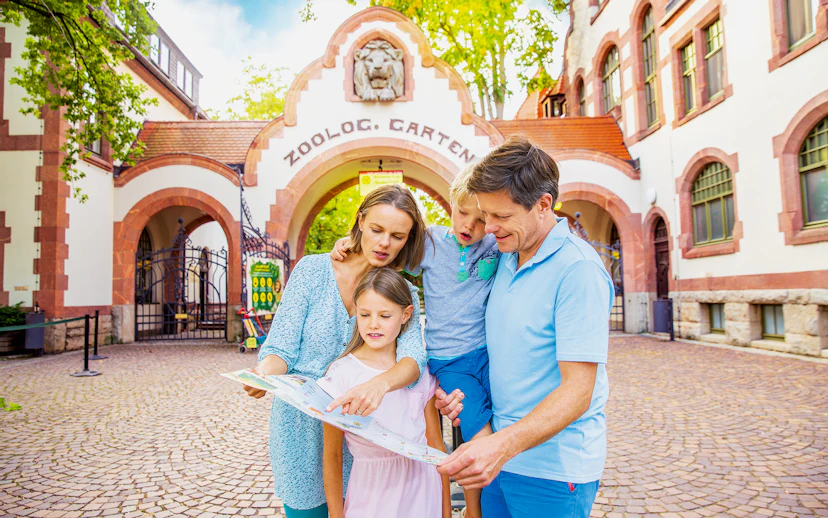
Zoo Leipzig plan your visit guide
Zoo Leipzig is a large city zoo best known for Gondwanaland, Pongoland, and some of Germany’s most ambitious animal habitats. It’s easy to reach, but the visit is bigger and more layered than many first-timers expect, with enough indoor and outdoor sections to fill most of a day. The biggest difference between a rushed visit and a good one is route order — if you hit Gondwanaland at the wrong time, you’ll feel the crowds fast. This guide helps you time your visit, choose the right ticket, and move around smartly.
Quick overview: Zoo Leipzig at a glance
If you want the short version before you plan the rest, start here.
- When to visit: Daily, with longer summer hours and shorter winter hours. Tuesday or Wednesday after 3pm is noticeably calmer than weekend late mornings, because families and school groups tend to cluster first around Gondwanaland, the elephants, and the boat queue.
- Getting in: From €25 for standard entry. Guided tour options start from about €10 per person. Booking ahead matters most for summer weekends, holidays, and combo products, while midweek walk-up entry is usually straightforward.
- How long to allow: 4–5 hours for most visitors. It pushes toward a full day if you add playground time, keeper talks, the aquarium, lunch, and the Gondwanaland boat ride.
- What most people miss: The Aquarium and Founder’s Garden are easy to skip late in the day, and the Koala House is small enough that many visitors walk past unless they’ve planned for it.
- Is a guide worth it? Usually not essential for a standard visit, but it adds real value if you want deeper ape, conservation, and breeding-program context without piecing it together from signs.
Jump to what you need
🕒 Where and when to go
🗓️ How much time do you need?
🎟️ Which ticket is right for you?
🗺️ Getting around
🐾 Which animals to prioritize
♿ Facilities and accessibility
Where and when to go
How do you get to Zoo Leipzig?
Zoo Leipzig sits just north of Leipzig’s city center, near Leipzig Hauptbahnhof and the Rosental green space, around 1km from the historic core.
Pfaffendorfer Straße 29, 04105 Leipzig, Germany
- Train: Leipzig Hauptbahnhof → 12–15 min walk → follow the painted animal-footprint trail toward the zoo.
- Tram: Zoo stop on Line 12 → 2–3 min walk → closest public transit drop-off for the main entrance.
- Car: Zoo parking garage / Talstraße area → 2–3 min walk → budget about €6 for up to 24 hours, and arrive early on peak days.
Which entrance should you use?
There is one main visitor entrance, but the practical split is between people who already have tickets and those still buying them. Most delays happen at the cashier line, not at the gate itself.
- Online and mobile tickets: For pre-booked visitors. Expect 0–10 min wait except on busy weekend openings.
- On-site ticket desk: For walk-up visitors. Expect 10–20 min wait on summer weekends and public holidays.
When is Zoo Leipzig open?
- Monday–Sunday: 9am–7pm (summer season)
- Monday–Sunday: 9am–5pm (winter season)
- Last entry: 1 hour before closing
When is it busiest? Weekends, school holidays, and 10:30am–2pm from June to August are the busiest windows, especially around Gondwanaland, the elephant area, and the boat ride.
When should you actually go? If Gondwanaland matters most, go right at opening or after 3pm, when the indoor hall feels less congested and the boat queue is usually shorter.
How much time do you need?
| Visit type | Route | Duration | Walking distance | What you get |
|---|---|---|---|---|
Highlights only | Entrance → Gondwanaland → Kiwara Savannah and lions → Pongoland → exit | 2.5–3 hours | ~3km | You cover the zoo’s biggest draws and strongest habitats, but you will likely skip the aquarium, Koala House, and quieter sections such as Founder’s Garden. |
Balanced visit | Entrance → Africa → Asia and Elephant Temple → Gondwanaland → Pongoland → Aquarium and Founder’s Garden → exit | 4–5 hours | ~5km | This gives you the major animal houses, the indoor hall, and time for one meal or keeper talk, without feeling like a forced march. |
Full exploration | Full loop through all themed worlds, plus playgrounds, boat ride, aquarium, keeper talks, and a lunch stop | 6+ hours | ~6.5km | You get the complete zoo, including the parts many visitors miss, but it is a genuinely long day and children usually need breaks built in. |
Which Zoo Leipzig ticket is best for you
| Ticket type | What's included | Best for |
|---|---|---|
Day Admission Ticket | Full-day entry + aquarium + Gondwanaland hall + keeper talks | A first visit where you want enough time to move freely across the zoo without committing to a fixed route or arrival window late in the day. |
Online Day Admission Ticket | Full-day entry + direct gate scan + Leipzig transit in zone 110 on the visit day | A busy weekend or holiday visit where avoiding the cashier line and covering your tram ride makes the day simpler from the start. |
Entdecker guided tour | 1.5-hour zoo guide + themed route + live commentary | A visit where you want stronger context around ape research, breeding programs, and conservation work than signs alone usually give you. |
Leipzig Zoo + Hop-On Hop-Off bus combo | Zoo admission + 1-day Hop-On Hop-Off bus pass + onboard audio guide | A short Leipzig stay where you want the zoo and a city overview in one purchase rather than planning separate transport and attraction tickets. |
Evening Ticket | Entry from 3 hours before closing + access to all open exhibits | A shorter, lower-cost visit where you’re happy to focus on key sections and skip the pressure of fitting the whole zoo into one afternoon. |
How do you get around Zoo Leipzig?
How is the zoo laid out?
Zoo Leipzig is divided into 6 themed worlds, and that matters more than people expect: you can cover the major highlights in about 3 hours, but a full visit with breaks easily becomes a 6-hour day. The biggest crowd-flow mistake is going straight into Gondwanaland at the same time as everyone else.
- Africa: Kiwara Savannah, lions, and large mixed-species views → budget 45–60 minutes.
- Asia: Elephant Temple, tigers, and other large mammals → budget 30–45 minutes.
- Gondwanaland: Indoor rainforest, boat ride, tropical species, and canopy paths → budget 60–75 minutes.
- Pongoland: Chimpanzees, gorillas, bonobos, and orangutans → budget 45–60 minutes.
- South America: Smaller tropical species and a quieter change of pace → budget 20–30 minutes.
- Founder’s Garden and Aquarium: Historic section, smaller species, and aquatic exhibits → budget 30–40 minutes.
Suggested route: Start with Africa and Asia if you arrive near opening, then do Gondwanaland before lunch or after 3pm, and save Pongoland for when you can slow down — it is one of the few areas where rushing really weakens the visit.
Maps and navigation tools
- Map: Zoo map on-site and online → covers themed worlds, dining, and facilities → download it before arrival so you can plan one continuous loop.
- Signage: Outdoor wayfinding is strong, but indoor transitions around Gondwanaland and the central zones make a saved map genuinely useful.
- Audio guide / app: Most visitors do fine self-guided because the themed worlds are intuitive, but a live guide adds more value than an app if context is your priority.
- Large outdoor POIs only: Offline GPS is unnecessary here → the only real navigation mistake is backtracking after Gondwanaland when you have not planned your loop.
💡 Pro tip: Don’t treat Gondwanaland as a quick indoor stop between zones — it is a major section, and entering without time set aside is what causes the most backtracking and frustration.
Which animals and habitats should you prioritise?

Gondwanaland
Habitat: Tropical rainforest hall
This is the zoo’s signature space — a vast indoor jungle that blends free-flying birds, primates, tapirs, dense planting, and elevated walkways under one glass roof. It’s worth slowing down for because the best moments are not staged; they happen when you look up, across the water, and into the foliage instead of walking straight to the boat dock. Most visitors rush the canopy bridges and miss how much animal movement happens above eye level.
Where to find it: In the central part of the zoo, inside the large glass-domed tropical hall.
Pangolins
Species: Pangolin
This is one of the rarest animals in the zoo and a major reason wildlife enthusiasts single Leipzig out from other German city zoos. Pangolins are easy to miss because they do not create crowds the way elephants or big cats do, but seeing one is the kind of detail that makes the visit feel distinct rather than generic. Most people walk past because they are focused on headline animals and never pause long enough in the darker house.
Where to find it: In the indoor animal houses where the rare-species displays are signed, rather than in the main outdoor headline habitats.
Pongoland great apes
Species: Chimpanzees, gorillas, bonobos, and orangutans
Pongoland is one of the zoo’s most important sections, not just one of its biggest. It stands out because you can compare all 4 great ape genera in one place, and the research-led design changes how you watch them — look for social interactions, enrichment objects, and how each group uses space. Most visitors give it a quick loop, but it rewards at least 45 minutes.
Where to find it: In Pongoland, a dedicated ape complex toward the back half of the zoo.
Kiwara Savannah and Makasi Simba
Habitat: African savannah and lion habitat
This area gives the zoo some of its best sightlines, with giraffes, zebras, and other large animals spread across a broad landscape and lions nearby in a separate but connected viewing rhythm. It is worth pausing for because the design hides barriers well, so it feels more open than many city-zoo savannahs. Most visitors stop for photos and move on too quickly instead of watching how the mixed-species habitat works as a whole.
Where to find it: In the Africa world, close to Kiwara Lodge and the main savannah viewpoints.
Elephant Temple
Species: Asian elephants
The elephant area combines one of the zoo’s strongest animal draws with some of its most memorable architecture. It is best known for elephant bathing sessions, but the real reason to linger is the chance to watch family behavior around the pool and yard rather than just waiting for a single splash moment. Many visitors crowd the glass briefly and leave before the elephants fully settle into view.
Where to find it: In the Asia world, around the Ganesha Mandir elephant complex.
Koala House
Species: Queensland koalas
Koalas are rare in European zoos, which is exactly why this small house deserves intention rather than a quick peek. The exhibit itself is compact, so what matters is timing — around feeding windows you are more likely to catch them awake instead of sleeping through the whole visit. Most people either miss it completely or arrive, glance once at a sleeping koala, and move on.
Where to find it: In the renovated historic Koala House, separate from the zoo’s larger outdoor worlds.
Facilities and accessibility
- 🍽️ Restaurants and snack stands: Kiwara Lodge is the best-known on-site stop, and food options are spread across the zoo, though inside prices are higher than many visitors expect.
- 🚻 Restrooms: Restrooms are distributed across the grounds, which matters on a long visit because you do not need to return to the entrance every time.
- 🛍️ Gift shop / merchandise: The main gift shop is near the exit and is the easiest place to pick up plush animals and zoo-branded souvenirs at the end of the day.
- 🪑 Seating / rest areas: Themed dining terraces, viewing areas, and playground zones give you natural places to stop before fatigue sets in.
- 🅿️ Parking: A dedicated zoo parking garage sits across from the site, costs about €6 for up to 24 hours, and can fill by late morning on busy days.
- 🩺 First aid / medical station: Staffed visitor facilities are spread across a well-managed site, which helps on a full family day with young children.
- ♿ Mobility: The zoo is stroller-friendly and easy to reach from the station, but a full visit still involves several kilometers of walking between large indoor and outdoor zones.
- 👁️ Visual impairments: This is a strongly visual attraction, so visitors who want more interpretation will get more from keeper talks and guided visits than from trying to rely on signage alone.
- 🧠 Cognitive and sensory needs: Gondwanaland can feel warm, humid, crowded, and visually intense, while weekend late mornings are usually the loudest period across the zoo.
- 👨👩👧 Families and strollers: Families generally find the site manageable because there are indoor refuges, playground pauses, and broad routes between the major sections.
Zoo Leipzig works well with children because it mixes major animals, indoor relief in bad weather, and enough playground time to break up a long day.
- 🕐 Time: 4–5 hours is realistic with young children, and the best short-route priorities are Gondwanaland, elephants, Pongoland, and one playground stop.
- 🏠 Facilities: Playgrounds, regular food stops, and widely spaced restrooms make it easier to pace the day without melting down by midday.
- 💡 Engagement: Build the route around 1 keeper talk or feeding session, because children stay far more engaged when they know one animal moment is coming up next.
- 🎒 Logistics: Bring snacks, a stroller if you need one, and one spare layer because Gondwanaland feels tropical even when Leipzig is cool outside.
- 📍 After your visit: Rosental is the easiest nearby decompression stop if children still need outdoor space before heading back into the city.
Rules and restrictions
What you need to know before you go
- Entry requirement: Day tickets, evening tickets, and online tickets all work, but concession visitors should bring ID or proof for the reduced rate.
- Bag policy: Bringing your own snacks and drinks is allowed, so a small day bag is practical for a 4–6 hour visit.
- Re-entry policy: Re-entry is allowed with a hand stamp, which gives you flexibility to step out and return on a full-day visit.
Not allowed
- 🚫 Feeding animals: Do not feed animals from your own food, even in the more open-looking habitats where barriers are visually understated.
- 🖐️ Climbing barriers or tapping glass: Both quickly disrupt viewing in indoor houses such as the ape, tropical, and aquarium spaces.
Photography
Personal photography is one of the strengths of this visit, especially in the open savannah-style areas. Indoors, the distinction is practical rather than complicated: low light and glass reflections make flash unhelpful in Gondwanaland, Pongoland, and the aquarium, while tripods and long setup stops become awkward on busy paths and near viewing windows.
Good to know
- The Gondwanaland boat ride is not included in standard admission, so budget a small extra fee if it matters to your day.
- Online tickets include local transit in Leipzig zone 110 on the visit day, which is easy to overlook and can save you a separate tram fare.
Practical tips
- Book online the day before or the morning of your visit if you are coming on a summer weekend — same-day planning is common here, and the online ticket also includes Leipzig transit in zone 110.
- There is no timed-entry pressure on a normal day ticket, so your real choice is full-day versus Evening Ticket rather than obsessing over an exact arrival slot.
- Save your best energy for Gondwanaland and Pongoland, because those are the 2 sections where people most often feel rushed and later realize they barely took anything in.
- If your priority is active big animals, be there close to 9am; if your priority is a calmer indoor rainforest, aim for Gondwanaland after 3pm instead of at noon.
- Carry your own snacks in a small bag rather than relying on buying everything inside, because food is convenient but regularly mentioned as one of the pricier parts of the day.
- Eat lunch a little early or after 2pm if you want a better shot at sitting by the savannah at Kiwara Lodge without the thickest midday queue.
- If you are visiting with children, plan one playground stop on purpose instead of treating it as downtime — it is often what makes the second half of the zoo manageable.
- Dress in layers on cool days, because you can move from outdoor Leipzig weather into Gondwanaland’s tropical heat within a few minutes.
What else is worth visiting nearby?
Leipzig city center and St. Thomas Church
Distance: 1km — 15 min walk
Why people combine them: It is the easiest same-day pairing, because you can leave the zoo and be back in Leipzig’s historic core without needing extra transport.
Panometer Leipzig
Distance: 3.5km — 25 min by tram
Why people combine them: It is another immersive, weather-proof experience, so it pairs well if you still want one more major indoor stop after the zoo.
Also nearby
Monument to the Battle of the Nations
Distance: 6km — 20–25 min by tram and bus
Worth knowing: This works best if you finish the zoo by mid-afternoon and still want one big Leipzig landmark rather than more city-center wandering.
Rosental Park
Distance: 300m — 5 min walk
Worth knowing: If you need a free, low-effort follow-up after the zoo, this is the easiest nearby green space for a calmer reset.
Eat, shop and stay near Zoo Leipzig
- On-site: Kiwara Lodge serves the most memorable on-site meal, and the savannah view is the real reason to choose it, though prices are higher than nearby city-center options.
- Leipzig Hauptbahnhof food hall (12–15 min walk, Willy-Brandt-Platz 5): Best for quick pre-visit coffee, bakery stops, and easy family fallback food without zoo pricing.
- Old Town cafés around Markt (15–20 min walk, Leipzig city center): Better for a sit-down meal after the zoo if you want more choice and better value.
- Station-area bakeries and snack counters (10–15 min walk, around the main station approach): Useful if you want to stock up before entry and keep lunch costs under control.
- 💡 Pro tip: If you want the savannah-side seats at Kiwara Lodge, eat before 12 noon or after 2pm — that small timing shift makes the difference between a proper break and a queue.
- Zoo Leipzig gift shop: The most practical souvenir stop, located near the exit, with plush animals and zoo-branded keepsakes that are easy to pick up at the end rather than carry all day.
- Leipzig Hauptbahnhof shopping arcade: Useful if you want more than souvenirs, especially for snacks, pharmacy basics, or a quick extra layer before or after the visit.
Yes, if your trip is short and you want easy logistics. The zoo’s location near the main station and the city center makes it one of the easier Leipzig attractions to build around, and you do not need a car to make the area work. It is less about neighborhood charm right outside the gate and more about being close to transit, the old town, and a major half-day attraction.
- Price point: The nearby station and city-center area tends toward mid-range and business-style stays, with cheaper options available once you move a little farther out.
- Best for: Short city breaks, family trips that want simple transit, and travelers who would rather walk or hop on a tram than plan a full transport day.
- Consider instead: Leipzig Old Town or around Hauptbahnhof if you want the easiest base for a short stay, and a more residential district if you are staying longer and do not need the zoo on your doorstep.
Frequently asked questions about visiting Zoo Leipzig
Most visits take 4–5 hours, while a full zoo day can easily stretch to 6 hours or more. If you want Gondwanaland, Pongoland, a meal break, the aquarium, and at least one keeper talk, half a day feels rushed. Families with playground stops usually need the longer end.
No, you usually do not need to book far in advance, but it is smart to buy online for summer weekends and holidays. A large share of visitors book only 0–2 days before visiting, so this is not a venue where you must plan months ahead. Online tickets mainly save time at the cashier and include local transit.
Yes, online tickets are worth it on busy days because they let you skip the ticket-purchase line even though entry security itself is not a big delay. The difference is modest midweek, but on weekends and holidays the on-site ticket desk can add 10–20 minutes before you even enter.
You do not need to manage a tight timed-entry slot for a standard visit, so arriving 10–15 minutes before you want to enter is usually enough. If you want the quietest start and the most active animals, aim for opening at 9am rather than arriving later and joining the midday Gondwanaland crowd.
Yes, you can bring a small backpack or day bag, and it is useful because outside food and drinks are allowed. That matters here more than at stricter attractions, since food inside is convenient but can feel expensive over a long family visit.
Yes, personal photography is a normal part of the visit, especially in the open habitat areas. The main practical limitation is indoors, where Gondwanaland, Pongoland, and the aquarium have glass, reflections, and low light, so flash rarely helps and large tripod setups quickly get in other people’s way.
Yes, Zoo Leipzig works well for groups, and guided options are available if you want more structure. School and youth groups are common, especially in the warmer months, so larger parties should avoid late morning bottlenecks and consider booking any guided component early if they want a set start time.
Yes, it is one of Leipzig’s strongest family attractions, especially for a half-day or full-day outing. The mix of big animals, indoor exhibits, playgrounds, and regular food stops makes it easier with children than attractions that are all walking and no breaks. Families usually do best with 4–5 hours rather than trying to rush it.
It is manageable for many visitors because it is a modern, stroller-friendly city zoo, but it is still a large site that requires a lot of movement. The main challenge is not getting there — it is the amount of ground you cover once inside, especially if you want the full loop of indoor and outdoor worlds.
Yes, food is available inside the zoo and there are more options within a short walk near the station and city center. Kiwara Lodge is the best-known on-site stop and worth it for the view, while Leipzig Hauptbahnhof and the old town give you more choice and often better value.
No, the Gondwanaland boat ride usually costs extra on top of your admission ticket. Standard entry covers the tropical hall itself, so you can still explore the rainforest paths and bridges without paying more. If the boat matters to you, budget a small extra fee and expect a queue at busy times.
Yes, there is a dedicated parking garage by the zoo, and it costs about €6 for up to 24 hours. It is convenient if you are driving in, but the garage can fill by late morning on peak days, which is one reason many visitors use the included transit perk on online tickets instead.